Monday, 19 December 2016

Review: Damien Chazelle’s “La La Land” is an early jewel in his filmography.

[Might contain spoilers, many of them.]

Boy meets girl. They are first a little aloof, but then keep bumping into each other. They are both struggling in their respective careers, and are stuck in jobs they do not like. They dream of bigger, better things. They fall in love. They support each other. And then comes that moment where they must decide whether they want to be together or pursue their dreams.

It’s a familiar template. And yet, in La La Land, the incredible new film by Damien Chazelle, each moment feels like a discovery. Not a ‘rediscovery’, mind you, but a discovery. It’s an old-fashioned romance told with so much imagination and style that none of it seems familiar. It makes us forget that we have seen bits of it before. Maybe in this film, maybe in that film – it doesn't matter. Here is a film that is going to take the familiar and turn it into something memorable. It promises as much in the first ten minutes. La La Land has us enthralled before it even gets going.

I am not big on musicals. It’s not a genre that appeals to me much. It’s difficult for me to find context when talking about them because I skipped watching them for the longest time. I have only seen a handful of them. And I cannot remember the last time a musical, from the very few I have seen, swept me off my feet the way La La Land did. (To think I grew up on Hindi films.) From its splashy opening number that plays out in a traffic jam in the middle of the day to its splendid final scene, it’s a film that made me want to sink my teeth into this genre. It’s an ode to a city, an era, and to those strugglers living out of suitcases who dare to dream. It captures the complexity of struggle and the beauty of wanting something so desperately that it drives you. It captures how love makes it seem, if only for a moment, that it's indeed possible to get anything that we want if we want it badly enough. Yes, it's nothing that we haven't seen before. Yet it is new, every moment of it.
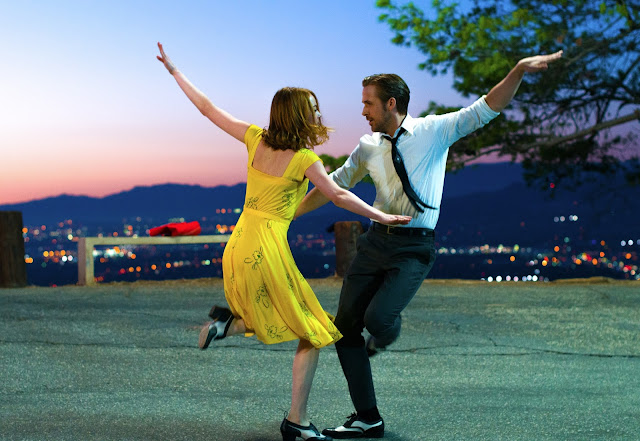


It's in the aforementioned traffic jam that Sebastian and Mia cross paths for the first time, he a struggling musician and she a struggling actress. They lead dull, unsatisfying lives. They are always hunting for opportunities to break out of it, to pursue something that makes them happy. They fail, and get back to their old lives. But Chazelle does not allow them to become sorry characters; he focuses instead on the sparks that fly when they are alone. The world around them ceases to exist when they are allowed to do what they love. Mia’s audition for a role is impressive; she can obviously knock it out of the park. But she does not get it. Sebastian’s job demands that he play a few standard Christmas tunes on the piano at a restaurant where nobody is paying him any attention, and he gets fired for leaving a room breathless when he, feeling suddenly inspired, drifts away and plays what he wants. She’s there, passing by, and she is left astounded. Fates intertwine.

Although these two sequences end on a sad note – both don’t ‘make it’ – they leave us feeling hopeful for them. Our attention is drawn to their passion and determination. They’re likeable underdogs. They soon find each other. They see themselves in each other. When they take a walk after a party, they impulsively break into a joyful song-and-dance routine. Failure does not bog them down. They keep going. It’s a film that belongs as much to its director as it does to its actors, and the magic that we see is as much a creation of its director’s as it is its actors’.

This is extremely confident filmmaking. Chazelle, who last made Whiplash, is adept at creating lovely moments that stay with you. Some involve dance, the others drama. When Sebastian, a purist, joins a band and, in a concert that Mia attends, plays the kind of music he does not believe in, Mia gets disillusioned. He's not the same person she fell in love with. She slips out before the audience begins cheering wildly. This is Sebastian's first brush with real success. But she does not see herself in him anymore. It's a terrific moment, when his success becomes their failure.

It only helps that Emma Stone and Ryan Gosling play off each other wonderfully. They infuse Mia and Sebastian respectively with such charm and feeling that we can't help but fall for the pair. Chazelle recognises this, which is why he lets them command the film. Even when a certain scene demands that they work without music, they make the film soar. Surprisingly, though, their performances aren't extraordinary. It is not a film that requires them to be, really. All the elements work together without overpowering one another. Rare.

La La Land is one of the best films of the year and an early jewel in Chazelle's filmography. With three films to his credit now, this guy seems to be warming up. His little touches are exquisite. Sometimes, it's not a question of whether the story a filmmaker chooses to tell is new or not. It's about how it is told.


(Not For Reproduction)

Friday, 2 December 2016

Review: Gauri Shinde's “Dear Zindagi” is a major misfire.

[Might contain spoilers.]

In one of the many, many exchanges in Dear Zindagi, Gauri Shinde's glossy sophomore film after her delightful debut English Vinglish, Shah Rukh Khan, playing a renowned therapist called Dr. Jehangir “Jug” Khan (why does every character who is a somebody in a Hindi film has to be ‘renowned’?), says, “Genius is knowing when to stop.” It's ironic that the line finds a place in a film that's about forty minutes too long in addition to being meandering and indulgent.

There were signs. There were signs. A rich and somewhat successful urban woman, Kaira, has emotional problems. She is dealing with stress everyday. She snaps at a guy who accidentally bumps into her in the park. She is an exposed nerve in the company of her boyfriends. She is popping pills. She is trying to decide between two projects with work environments she knows she won’t be comfortable in. We don't think she will make it through either of them. She is like a castle of cards that would fall apart with a gust of wind. Vulnerable, clearly in need of help.

When a film is titled “Dear Zindagi” and it presents a character like this one, we somehow get the idea that it will be dosed with a healthy amount of optimism. And here the dose of optimism presents itself in the form of Jug, the ‘cool doc’. A ray of light in a dark, musty tunnel. Jug understands her, helps her open up and open her windows to a more hopeful world slowly, one session every week. 

It is a film that keeps its ambitions low. To Shinde’s credit, she manages to do two things unique to a Hindi film: Approach mental illness as a serious subject as opposed to an overexploited joke, and build a narrative around the conversations the doctor and patient have. She also tries to get rid of the stigma surrounding therapists. (In parts, the film did look like an overlong advertisement for therapists. I counted at least four instances where we are told that it's okay to sometimes see them.) But the problem here is Shinde’s forced dialogue that tries really hard to be free-flowing while also trying to sound profound, often failing in this regard. Its conscious, self-congratulatory tone creates a barrier between us and the characters. It goes on endlessly without purpose, without saying anything even when the characters are constantly speaking. When Jug gives an example of trying out many chairs before settling for the best one to analogise Kaira’s failure of finding the right guy, it comes across as stale. It’s the sort of theory that doesn’t work in a film anymore only because it’s hackneyed. But Dear Zindagi loves it.

Image credits: www.indianexpress.com


After a while, the pattern became clear: One life lesson per session. While Kaira looks forward to it, we don’t share her eagerness. These sessions are sermons where anecdotes are shared and the past is brought up. There is a nod to Good Will Hunting and even a really tiny one to Analyze This. But the more inspired and original bits are drowned by the long stretches of dialogue before and after them. We crave for more plot, something to break this pattern. As we expect, Kaira’s nervousness is because of a memory that has tainted her childhood. Her vulnerability stems from it. These vital pieces of information, our key to understanding Kaira, come far too late and all at once. By then we are long past caring. Or maybe just I was. 

What made English Vinglish so charming was its sharp writing that, for the most part, avoided preachiness. Dear Zindagi openly embraces it. There are snatches of dialogue that are sharp, reminiscent of the kind of writing we saw in English Vinglish, but they vanish after the character of Dr. Jehangir Khan is introduced. With him comes superficiality. And superficiality has no place in a film that revolves around conversations. It ebbs the actors' charms. The performances are very good, but it’s a shame I could not warm up to them due to this.

Dear Zindagi is a hit-or-miss proposition, really. Those who can relate to the character of Kaira might appreciate what Shinde is trying to do here, but those who can’t might find it hard to adapt to the film’s didactic approach. It might prove to be effective for some considering the film is about a woman opening up to a therapist and is meant to be talky, but this sort of approach lacks shrewdness. Even in its final moments, Dr. Jehangir Khan wasn’t done with his life lessons. I lost count of the number of times I sighed out of boredom and just wished that they had gotten Goa’s characterisation right at least. 

(Not For Reproduction)

Monday, 31 October 2016

Review: Karan Johar’s “Ae Dil Hai Mushkil” is a buzzkill.

[Contains spoilers, many of them.]

Not being much of a fan of melodramas, I have always steered clear of Karan Johar’s films. My only brush with his cinema was his well-executed instalment in the anthology film, Bombay Talkies. I don’t know his “style,” but I am told he makes out-and-out melodramas about affluent and good-looking people having problems with each other. I believe the term often used to describe his films is “weepathon.” But there’s one characteristic about Johar the filmmaker that nobody can disagree with: He has a loyal audience, and he knows exactly what they want.

I don’t know how I wound up in the theatre to watch his latest, Ae Dil Hai Mushkil, but I was sincerely praying that I wouldn’t have to sit through a “weepathon.” In 21st century terms, the film is about a guy who gets into the “friend zone,” panics, and then attempts to get out of “the zone.” Over the course of 158 minutes – which feel like eternity – it captures the entire process of getting in, panicking, and trying to get out. This is accompanied by gorgeous locations, actors who look impeccable in every frame, and a bunch of cameos. A picture wrapped up in gloss about people suffering beautifully is a gift to us to mark the festival of lights. It doesn’t sound too bad until we realise what we have got ourselves into. 

Ae Dil Hai Mushkil kicks off with Johar bringing a surprising lightness of touch to one overwritten scene after another, something he isn’t known for. Although he follows the spoilt-brat-bumping-into-a-woman-who-changes-his-life formula loyally, he’s ignoring his own approach to a story here. Melodrama is mostly kept at bay, but there are still cringeworthy moments of indulgence and theatricality. He tries too hard. The actors try too hard. We don’t get enough opportunities to understand the characters they portray. We have met the characters before: He’s the introverted and confused son, a man-child, of a wealthy father, and she’s the buoyant and carefree woman who gets excited by just about everything. We don't know what drives them, how they see the world. It’s hard to feel for such thinly written characters, and it’s important to feel for them because we know a love story will be blossoming between them soon. (We are, after all, watching a mainstream Hindi “Diwali” film.) The story just needed to breathe, to develop naturally, but Johar doesn’t let it. 

Through the first half, the film coasts along like an old train on rusty rails: It’s somehow doing what it is supposed to, but there is no telling when it will collapse. One misplaced detail, one little bad scene or a weak plot point and it’s going to go down. (The moment does arrive near the end.) It’s strangely thrilling to watch how it tries to balance itself with its excesses and innumerable flaws, because we sense a confidence here. It’s happy to be what it is, happy to be flawed. It’s delivering what most Hindi “Diwali” films try to deliver: Digestible fun and frolic. Some people, like me, cannot watch something as self-aware and extravagant as this. But we understand that we are not the audience Ae Dil Hai Mushkil was made for.

The love between them does not blossom. The guy does not get the girl. He tries to be content by keeping her in his life as his best friend. He gets into a relationship with a mature and lovely Urdu poetess who lives in Vienna (hmph?), and who, for the first time, accepts him as a man. This is his first mature relationship. There is a moment when the best friend meets the new girlfriend, and the girlfriend wants to know why the best friend never fell for him. The best friend replies that she got a baby in a pram, not the mature person the girlfriend got. We inexplicably get the feeling that this exchange was supposed to be the film’s crowning moment. A man’s soul mate and his dream woman are sitting across each other and talking about him. The dream woman is curious; the soul mate, full of feeling. This moment could have been melancholic for the sake of cinema, but, thanks to its awkward execution, it is reduced to a sad little joke. 

Finally, a sudden – and terrible – “plot twist” in the third act crumbles the film. At least till that point the film was managing to keep itself from coming apart. From then on, I didn’t stop cringing till the lights came back on. There is absolutely no justification given for its inclusion except that perhaps we hadn’t cried enough. It comes across as Johar’s last-ditch attempt to make us cry. We still don’t. It just doesn’t work.

I discovered a way to analyse how different I am from the film’s target audience while watching the film in the theatre. A huge group of forty-somethings had occupied the row behind mine, and they laughed when the film wanted us to laugh, cried when it wanted us to cry. Rarely did we respond to it in the same way. I suppose it worked for them. Maybe I am just not cut out for Johar's cinema. 

(Not For Reproduction)

Sunday, 23 October 2016

Review: Jonas Cuaron’s “Desierto” is neither terrifying nor particularly thrilling.

[Contains spoilers, many of them.]

Jonas Cuaron’s Desierto, the Mexican submission for the Oscar for Best Foreign-Language Film this year, should have worked. It does not.

There is no doubt that it will find a place in the current political climate. Immigration is a topic currently in the spotlight, thanks to a demagogue who has been opposing it vociferously. We read about incidents in the papers where immigrants have been attacked or threatened for no reason at all. So, a minimalist film about immigrants being hunted down like animals couldn’t have come at a better time. We think it will be urgent and exciting, not limp and ineffective. Certainly not limp and ineffective. But Desierto – well, you can guess.

It opens with a truck carrying illegal immigrants breaking down in the middle of a parched desert along the US-Mexican border, who then continue the journey on foot. On the other side of the desert, a drunken and clearly racist lunatic hunting rabbits notices them, and then, on a whim, decides to pick them off one by one. It’s not a random act of violence; he chases the ones who get away for two days without pausing for breath. For him, it’s a game where he has the advantage, a game in accordance with his beliefs. The unarmed immigrants have no option but to run, to hide, and to save themselves. But stranded in the hot son and in the middle of the seemingly endless expanse of a rocky desert, where could they run?

Like Gravity, Desierto makes it clear in its first ten minutes that it will be a straightforward, if simplistic, survival thriller. It was probably meant to be that way. If anything was different, like a villain with a conscience or maybe a bunch of immigrants who fight back, it would have compromised on its power to provoke. It wants to be provocative, so much so that there is no attempt to provide any background to any of the characters. They are markedly categorised into two groups: the unarmed and helpless are the good guys, and the armed inebriate is the bad guy. We just know that one of the good guys has a son somewhere. He's the good guy because he has a son, a family. The bad guy, well, has a dog, a savage one. He swigs from a bottle, laughs, and woohoo’s after massacring most of the group. Then he yells, “It’s my home!” in case we had any trouble figuring out just how evil he really is. So much for subtlety.

(Image source: www.screenrelish.com)

Like Gravity, Desierto makes it clear in its first ten minutes that it will be a straightforward, if simplistic, survival thriller. It was probably meant to be that way. If anything was different, like a villain with a conscience or maybe a bunch of immigrants who fight back, it would have compromised on its power to provoke. It wants to be provocative, so much so that there is no attempt to provide any background to any of the characters. They are markedly categorised into two groups: the unarmed and helpless are the good guys, and the armed inebriate is the bad guy. We just know that one of the good guys has a son somewhere. He's the good guy because he has a son, a family. The bad guy, well, has a dog, a savage one. He swigs from a bottle, laughs, and woohoo’s after massacring most of the group. Then he yells, “It’s my home!” in case we had any trouble figuring out just how evil he really is. So much for subtlety.

Desierto suffers from the same problems as Gravity, which Jonas co-wrote with his father, Alfonso Cuaron, but, notably, also has similar strengths. Our protagonists here, like the protagonist there, want to escape to safety. They need to improvise a way to get there with a lunatic and his loyal dog hot on their trail. We are filled with horror when the gun-toting bad guy attacks them for the first time, but that feeling doesn’t quite return even when the others are eliminated in gorier ways. Owing to a poor screenplay and inadequate character development, Cuaron turns a promising premise into a mostly predictable mess. It’s a slog where we feel nothing at all. We can’t be blamed, though; the characters in the film hardly show any emotion, whether empathy or fear, when their companions are killed. They remain unaffected, panicky. And if they can’t summon empathy, how can we?

Somewhere in the second half of the film, I lost all interest. It was too late to expect it to give me something more. The villain became unimaginably caricatural with his occasional murmuring of “Let's get them,” and even uttered a roar of anger at one point. (Oh, come on!) The last remaining immigrant – played by the ever-reliable Gael Garcia Bernal – tries to dodge him in the inevitable final chase, not fighting back even when his life is in mortal danger. It became frustrating. The most he does is utter a cry of helplessness to counter his hunter’s roar of anger. Such flatness overwhelmed me. The one-sided perspective managed to inspire some sympathy, but it made it less of a thriller. And that is a major flaw, even if the intentions behind it were noble.

Apart from stray moments of terror and wonderful work from cinematographer Damian Garcia, Desierto manages to remain mostly unimpressive. Some thrillers lack heart, others cleverness. This one lacks both. It's disappointing to see it being reduced to a rubble.

(Not For Reproduction)

Monday, 19 September 2016

Review: Aniruddha Roy Chowdhury’s “Pink” is a solid film but leaves a lot to be desired.

[Might contain spoilers, many of them.]

Reviewing a film like Pink can be tricky. It touches upon an issue so alarming you want to applaud it for doing so in a mainstream Hindi film. What it wants to say is absolutely essential and relevant and we must listen. And yet, how much you end up liking it depends largely on how you like your courtroom dramas, not how noble its intentions are. I like them to be understated. I would prefer if things weren’t spelt out for me. I enjoy the opaqueness. Hindi cinema has rarely produced such courtroom dramas, but I digress. 

Aniruddha Roy Chowdhury’s Pink isn’t one, but it doesn’t aspire to be one either. In fact, it wants to make its points heard loud and clear at the cost of subtlety. It does manage to do that with some anger and some theatricality – the two are rarely part of the same scene – but it leaves a lot to be desired. 

In the opening minutes, the setup is established neatly and with a considerable amount of mystery. Three girls return to the Delhi flat they share in silence, and there is an uneasiness about the way they go about doing everyday things. In another part of the city, a guy bleeding profusely through a gash above his left eyebrow is brought to a hospital by his friends. As the film progresses, a few more details emerge. One of the girls was the reason he almost lost an eye to the injury. There are conversations about forgetting what happened and moving on, but the men are not willing to let things be. They want an apology. There is open intimidation between the two parties and then a flagrant attack.

Chowdhury seems to be in complete control of the film till this point, allowing us enough details to work out what happened for ourselves. We gauge the power on both sides. We know the girls are underdogs, just ordinary workingwomen in Delhi. The men have political connections and come from money. They have no qualms about going to the law. And from how blatantly they molest one of the girls in a moving car in one of the film’s most horrifying sequences, we know the impending victory for the girls won’t be without difficulties. 

On their side is Deepak Sehgal, a retired lawyer who was once popular and who feels obligated to represent the helpless girls in court. He is also their creepy neighbour, a cranky old man who wears a pollution mask that makes him seem more savage than the shadows on his face. (I can almost see him turning up in the nightmares of the kids from the neighbourhood.) He’s one of the two men who spend their evenings peeking into the girls’ home without reason. Sehgal, we find out, is concerned; he feels an inexplicable connection to them. He wants them to be safe. The other man’s intentions are obscure. Why does he do that? Is he one of those regressive people who think independent women are acting “against Indian culture” by living alone together or does he feel entitled? Either way, it’s extremely worrying. It’s not surprising when he turns up later in the film and attests to the girls being of “questionable character.”


When Sehgal readies his guns to defend the helpless and frightened girls in court, Pink enters a familiar territory. We were introduced to brave women who stood by what they believed in, who fought back, but here they are reduced to a stuttering mess. Now they need a protector, someone vigilant, who can help them fight the world. Sehgal becomes that person for them. He becomes their father figure. In some of the scenes where the actual father of one of the girls turns up, we barely register his presence. The character doesn’t get enough screen time to earn our sympathy. 

But that is beside the point. Their transformation is unnerving. We desperately want them to stand up to the world, represented here by the prosecution lawyer who is regressive, strident and brutal in his approach to take them down. But they are right in the face of a society so oppressive that being brave can be foolish. There are exactly two moments when they do snap and stand up for themselves in the court of law, and Chowdhury milks those moments for their emotional power. The film’s chief arguments are presented with such bluntness that we are left a little dazed. They are that provocative. But, the heightened drama makes us cringe. The message is gotten across – or shouted across – at the exact moment when using subtlety would have made it a stronger scene, a stronger film

Pink isn’t without a couple of nice touches, most of them sketching the character of Sehgal for more clarity. In possibly the best scene of the film, the lawyer and one of the women are taking a stroll in the park when they cross some young men who recognise her from the scandal. She is quick to cover her face with her hood, but the lawyer silently removes it. He knows there’s truth on their side. She has nothing to hide. She has to learn to live with dignity before the trial is even over. It’s a superb, superb scene that reiterates his new role of a father figure to her. In another scene, as the antagonist takes the stand and is about to testify, Sehgal objects and unexpectedly reads out the man’s enviable educational qualifications to show him that he’s aware of them. And then, with a deadpan expression, he concludes with: “Could you please take your hand out of your pocket?” It’s like he was delivering a joke just to relish the punchline. We sure do. It’s cathartic. 

As the film wears on, however, it becomes increasingly predictable and winds up so neatly that I had a hard time accepting the ending. Any reasonable person would. The bad guy loses his mystique and starts acting like a regular villain in a Hindi film. He openly defies the defence lawyer in a critical scene, becoming the face of regression, and the defence lawyer finally gets the better of him like most heroes do in Hindi films. It’s a happy ending, that’s for sure. But why does a happy ending mean that the film must eschew realism? Maybe giving it a not-so-happy ending would have made a good case against the flimsy justice system, but Pink isn’t interested. Oh, well.

Finally, though, it leaves us with something to ponder over: If the film’s biggest flaw lies in its end credits, does it mean that it is its biggest triumph or failure? Triumph because many could have missed it. And failure because, well, many could have missed it. The sequence that the makers cleverly avoided showing, the one that formed the crux of the story, plays over the end credits before Amitabh Bachchan’s voice booms from the speakers with a poem. It’s almost as if the makers feared we had had trouble figuring out what happened or getting the film’s message. I don’t understand why it didn’t just end like it began: in silence. I don't understand the eagerness to not leave things a bit hazy. I just don’t.

(Not For Reproduction)

Sunday, 4 September 2016

Essay: Filmmakers can choose to tell any story the way they want to. Yes, indeed.

[This piece comes in the wake of some people accusing filmmakers of having “ulterior motives” by picking controversial stories to tell.]

I’m not in the habit of judging people. And I’m certainly not in the habit of judging filmmakers.

I can choose to watch their work and I can choose to review it if I want to. If I do not like what I see, I can choose to refrain from commenting on it, or I can choose to write about what I did not like. I have that power over filmmakers, and to be honest, I do enjoy it. It gives me the right to decide something for myself.

But sometimes, I fear it. Why do I fear it? Am I fearful of them tracking me down and hitting me on the head with a brick? Maybe. But the fear I’m talking about is a different kind of fear. I fear I may be wrong about it.

There was a tiny problem I used to face often when I started out writing reviews: If a film I watch contains themes or sequences I have an objection to, because they go against my morals, do I call that film “bad”? Just because the filmmaker does not believe in the same things I do? That the filmmaker is so tactless that they decide what I should believe in? I believe I saw something objectionable in a film. Now I am outraged that someone was trying to convince me it is right. That’s right; that filmmaker had ulterior motives! Otherwise why would they include it in the film?

If that is how it works, I am not aware of it. Is there a rule written anywhere that people who make movies – or any kind of people, really – have to believe in the same things I do? Or have to believe in the same things that the general consensus says is right?

The answer is no. Filmmakers are not obligated to believe in the “right” things, and they are not obligated to tell us what’s “right.” They are not obligated to make “right” films either.

A film is a form of expression. It’s a cliché. We all know that. It can choose to tell a story or just be the product of a person experimenting with the form. Or maybe discuss an idea. It can be about anything. It can be about everything.

When I am watching a film, I do not make the mistake of forgetting that it is subjective. It’s a person’s viewpoint. It does not represent what a group thinks, or an industry, or a community, or an entire people. It represents what one person thinks. Maybe two or three. But definitely not a large number of people, simply because a single person cannot speak with a degree of conviction for a large group. 

I’m allowed to expect things from it. I’m allowed to expect sensitivity on the part of the makers, partly because no filmmaker knows what kind of an audience their film will garner. They don’t know who will watch their film, where or when. The target audience may not be the target audience after all. If the themes in a certain film are delicate, they should be dealt with in a certain way. Complete freedom dictates that a film can be made in any way the maker wants to, but a little sensitivity never hurt anyone. Why upset anyone for no good reason? Now that is moral, but again, it is not imperative.

In the four years I have spent writing film reviews, I never pinned a label on someone and told them they’re something. I have chosen to be a critic or an admirer of their work, but not of them as a person. I have never indulged in trying to figure out what kind of people they are from the work they have done. My ethics prevent me from making that judgment.

Cinema moves me, but seldom does it carry enough weight to influence the way I think. I’m too proud a person to that gullible. And I do feel a pinch of disappointment when a controversial story is told safely, without trying to actually say anything new.

There is no “right” film and there is no “wrong” film. If such an concept is introduced, absurd it very well may be, it's bound to become a threat to creative freedom. Something that is worse than a “wrong” film is a film made out of fear. Such a film does not indicate a healthy environment for artistic freedom, and a creatively oppressed country is not a free country.

We can choose to listen to filmmakers, argue with them or embrace them. The choice is ours. But we cannot reach conclusions about their character or intentions. In doing so, we are stepping into shoes too big for us. And those shoes didn’t belong to us in the first place.

(Not For Reproduction)

Friday, 19 August 2016

Review: Raam Reddy's "Thithi" is an incredible debut.

[Might contain spoilers, many of them.]

In the opening scene of Raam Reddy's Thithi, an old grouch spares no one walking past him as he gibes at them. The men get yelled at, the women barely get more than a murmur. People ignore him, a detail that suggests that he has been doing this for quite some time, and a group of children giggle at his antics. And when he gets up to relieve himself, he slumps over and dies. In a matter of minutes a small group of people discover him lying in the dust and declare him dead.

This particular sequence tells us a lot about what is to follow, and marks the film's first triumph. A world is created, a world of sounds and sights, a lived-in world, within the first five minutes. Before we meet the folk of the village of Nodekoplu, we are already familiar with them and their milieu. We don't need the introductions, really. They can be skipped. But they are not. We are introduced to them again but in a different, more delightful way. Now the news of the centenarian's death has to travel and reach his son, grandson and great-grandson. We see their apathetic reactions to it and then, understatedly, the people's. They begin talking about a grand farewell, grand because the man lived to be a hundred, and getting the rituals done properly, their eagerness to do so not being shared by any of the dead man's kin. But most of all they talk about the feast.

Thithi captures the flavor and the color of rural India quite unlike any other film in recent memory. Like all films set in Indian villages, fictitious or otherwise, it is a busy one, bursting with characters and situations, seamlessly jumping from one to the other. It's like watching one of those old Hindi television programs that revolved around a bunch of likable characters picked out from everyday life and their repartees. (I wouldn't have been noticed if Thithi played with the Doordarshan logo on the top-right of the screen.) But it is a film with its own wit, its own characters, its own world, and its own identity. For someone like me who isn’t clued in to Kannada cinema, it comes across as a breath of fresh air. A more distinctly Indian film has not found its way to the theaters this year, and I reckon there will not be.

The old man owned a piece of land that should be inherited by his son now that he is dead. But the old drunkard with a lion-like mane of white hair who loafs around all day clearly isn’t the ideal candidate to be declared its owner. He would probably sell it off for a small sum to buy more hooch. His son, a responsible individual with a family to feed, instantly tries to get his hands on it. It’s not greed, we find out; it’s a reasonable decision. But the father and his son have had a falling out. Working from a wonderfully layered script he co-wrote with Eregowda, Reddy communicates the stiffness the father-son duo share through a terrific scene. The son is disgusted by his father’s habit of wandering aimlessly armed with a tiny bottle of rum all day. The father is still somewhat tender towards his son although there is cautiousness in the way he deals with him, and the son can only broach the topic of the piece of land. No pleasantries are exchanged. The argument is heated on the son’s part but diplomatic on the father’s. Reddy’s talent is evident in the way he handles the scene, saving us a flashback where we would have seen them having the argument that led to their fallout for the sake of a little more clarity. A lesser filmmaker would have settled for it. We don’t get the flashback, of course, because we don’t need it. The actors, both non-professionals like the rest of the cast, shine. And when we are in such good hands, we need not worry.


For me the greatest films have many memorable moments but no standout scenes. There’s consistency found in them. I have always believed that the best scenes in any film hog our attention and deny us the pleasure of experiencing the film as a whole. We always look forward to the next few scenes to measure up to the finer ones, only to be disappointed when they don’t. Consistency eternalizes them, because we remember the impact the film had on us as a whole, not the sum of its strongest parts. Thithi is one such film. One will talk about this moment in it or that moment in it, savor it repeatedly as they discuss it, but would be at a loss for words when asked to talk about its strongest scene. Each sequence comes with its own magical bits, its own moments.

But the film is all about its characters. Whatever little plot this film has is only a backdrop for us to observe them, observe how situations define people and how they change them, bringing out the best and worst in them. In this case, the dead man’s thithi ceremony serves as one, and in the busyness and small-scale chaos that follows, we get to see how it has influenced the characters to be different people. The son has no qualms about bribing his father to disappear for a few months so that he can usurp the land owned by him, and his son has no qualms about stealing from the naïve girl he has taken a liking to. Their villainy, if we could call it that, is not lingered on for long because circumstances have dictated their behavior. They may be likable people but that cannot keep them from committing bad deeds, even if the people they stand to hurt are related by heart or worse, by blood.

In its third act, Thithi is at its busiest. Threads need to be tied up, stories need to be concluded. It’s a bit overwhelming to keep track of everything, and in some places it feels like too much is happening. But till its pensive final shot, it remains both playful and thoughtful. In pitch darkness, the righteous old inebriate who has infuriated his son by unknowingly spoiling the land deal sits in front of a fire, away from the ceremony now in its last stage. The village readies itself for a performance. He doesn’t want to join in the fun. He would much rather light a fire in the darkness.

(Not For Reproduction)